INTJ Careers: The Best Jobs for INTJs (From an Actual INTJ)

I have never lost a game of Risk, a fact my family treats as a war crime and I treat as the first line of my résumé. Board games were the first place my brain got rewarded for doing what it does anyway: planning three moves ahead, modeling what everyone else at the table wants, and refusing the move that feels good in favor of the one that wins.
I’m an INTJ, the personality type 16 Personalities pegs at about two percent of the population, and under one percent for women. I wrote about what that felt like back in 2015, as a USC student who assumed the type was something to manage. Eleven years and five jobs later, I have a different read: the traits that make INTJs lonely at parties are the same traits certain careers pay a premium for. This is the list of those careers, from someone who has held several of them.
The search that brought you here is some version of what careers are best for INTJs, and most of the pages answering it were written by nobody in particular. So here is mine, with the jobs I would take tomorrow, the ones I would run from, and the job board my husband Kyle and I built partly so INTJs could stop applying to roles that want a 9am standup.
The best careers for INTJs pay for strategy and protect deep work: software engineering, data science, writing and editing, strategy consulting, product and systems design, law, finance, research, architecture, and founding something of your own. The worst ones fill your calendar with meetings and reward you for being available instead of being right.
The Best Careers for INTJs
Ranked by how well each one pays for the INTJ wiring, with the cost of each, because every job has one.
1. Writer, Editor, or Ghostwriter (My Lane, Obviously)
I put my own field first with full awareness that this is a writer’s blog. Writing is 99 percent sitting in a room by yourself making the people you dreamed up interact on a page, which is the INTJ dream job description. I have been a TV writer, a memoir ghostwriter, and a novelist, and the throughline is the same: a large system (a season, a life story, a five-book world) that has to be planned before it can be built, then executed alone for months. Ghostwriting in particular rewards the thing INTJs get accused of, which is listening more than we talk. If you want the specifics, my guide to how to become a ghostwriter has the rate card, and my list of writing job boards that actually pay has the doors.
The cost: the parts of the job that are not writing. Pitching, networking, marathon meetings around Los Angeles selling yourself and your fictional creations to executives. I did those for years, and the room I was in closed in the 2020 chaos anyway. Freelancing let me keep the writing and drop most of the room.
2. Software Engineer
The job most lists put first, and for good reason: it is systems thinking with a compiler that tells you when you are wrong. Long blocks of solo focus, problems with a definite right answer, and a culture that (at its best) values shipping over showing up. My husband Kyle works in tech, and we built CozyJobs together, so I have watched this job up close: the good version is long, uninterrupted problem-solving with a right answer waiting at the end.
The cost: the bad version is a standup every morning and a Slack channel that never sleeps. Ask about meeting load in the interview. Actually, ask about it in every interview on this list.
3. Data Scientist or Analyst
Pattern recognition as a paycheck. INTJs are the people who notice the thing in the spreadsheet that everyone else scrolled past, and this job pays you for exactly that, with the added pleasure of being right in a way you can prove.
The cost: a lot of the job is explaining the chart to people who wanted a different chart. Diplomacy is a learnable skill, and it is a skill.
4. Strategy Consultant
Someone hands you a broken system and pays you to see the whole board. Consulting firms hire for exactly that, and they know which personality test to run.
The cost: travel, client dinners, and a calendar owned by other people. The independent version of this job (advisory work, fractional roles, a paid newsletter with a point of view) keeps the thinking and drops most of the airport time. It is roughly how my own consulting went from a side thing to a $1,000 an hour line item.
5. Product Manager or Systems Designer
If the engineer builds the thing, the product person decides what the thing is, and INTJs are built for deciding. Roadmaps, tradeoffs, saying no to the shiny feature: this is strategic work with a shipping date.
The cost: it is the most meeting-heavy job on this list, and the meetings are the job. Great for INTJs who have made peace with the rubber band (more on that below), rough for the ones who have not.
6. Lawyer
I almost went to law school. The appeal, for me, was the architecture: rules and precedent, and a long argument built in private before anyone hears it. Contracts, appellate work, and policy are the INTJ corners of the profession.
The cost: billable hours and a decade of dues before the interesting work. I chose writing instead. Ask me in another decade whether that was the strategic call.
7. Financial Analyst or Investor
Long-horizon thinking, models that either hold or do not, and a scoreboard. INTJs who like being measured tend to thrive here.
The cost: the culture. If the phrase “crushing it” makes you tired, choose the research side over the sales side.
8. Scientist or Researcher
Deep work with a question at the center and years to answer it. Academia and industry research labs are two of the few places where sitting with one problem for a very long time is the job description rather than a red flag.
The cost: grant cycles, committees, and a pay scale that does not reward the depth it demands. The Opportunities tab on CozyJobs lists grants and residencies for a reason.
9. Architect or Engineer (the Building Kind)
You imagine a structure in full before a single beam exists, then you defend the plan against physics, budgets, and clients. The INTJ nickname on 16 Personalities is literally the Architect. The type test is not subtle.
The cost: long licensure paths and clients who want the plan changed on Friday.
10. Founder (of Something Small and Yours)
I have built a freelance business, a newsletter business, and a job board, and I will tell you the truth about founding as an INTJ: the strategy part is the easy part. What you are signing up for is being the plan, the labor, and the person who has to sell it. I grew Make Writing Your Job to 49,500-plus subscribers over three years with no paid ads, which sounds like a strategy win and was mostly a consistency win: I published every week for three years, including once from a hotel bed in Athens with a fever.
The cost: nobody hands you the door that closes. You build it, and you pay for the hinges.
Careers INTJs Should Think Twice About
Let’s get real: there is no job an INTJ cannot do, and there are several that will charge you a fee in energy every single day. Watch for these.
Any role where the calendar is the product. If the job is being available (scheduling, coordination, on-call anything), you will do it well and resent every minute of it.
High-volume, interruption-driven work. Front desks, live support queues, open-floor sales. The interruptions are the job, and your brain will spend all day trying to finish a thought.
The assistant path in creative industries. I was an assistant to a TV lit agent at 22, writing at a Coffee Bean at 5am before the phones started. I thought it was a ladder. It was a dead end with a great view.
Roles that pay in exposure and promise meaning. INTJs are unusually good at spotting a bad system, and unusually likely to stay inside one to fix it. Don’t.
One caveat, from the book that shaped how I think about all of this, Susan Cain’s Quiet: personality is a rubber band. You can stretch it for a job you want, and I have (pitch meetings, a 12-hour launch livestream, live classes for thousands of newsletter readers), as long as you stretch back. The mistake is choosing a career that keeps the band stretched permanently.
How I Built an INTJ Career
For the record, here is the path, because career advice from someone who never shows their work is just a mood board.
USC film school, then an assistant desk at a TV lit agency at 22. Learned the machine.
A TV writers’ room, where I co-wrote an episode of Condor. Deep work in a group, which taught me that INTJs collaborate fine when the group is small and the problem is hard.
The 2020 chaos closed the next room I was in, so I went all in on freelancing. My income tripled. I have since billed more than $300,000 on Upwork alone and, on my best days, $1,000 an hour, working mostly async from wherever the Wi-Fi was.
Four books, a newsletter with 49,500-plus subscribers, and a job board built with Kyle. Every one of them started as a plan on a page.
The pattern: every move traded a job that scheduled my day for one that scheduled my output. That is the INTJ career in one sentence, and you do not need to found anything to get it. Most INTJs I have worked with want a role with a door that closes and a problem worth the silence.
🛋️ Find INTJ-Friendly Jobs on CozyJobs
Okay, yes, I built this job board (with Kyle), so take the plug with the appropriate salt. We built CozyJobs because most job boards make you wade through roles that want a personality you do not have. CozyJobs has a page that matches live jobs to INTJ strengths (strategy, systems thinking, deep autonomous work) across thousands of jobs on a board updated daily, in creative fields, remote, hybrid, and in-person.
📬 Daily emails that match jobs to your profile, so you can stop refreshing.
📋 A free application tracker, no paid plan required.
⚡ CozyApply, our browser extension: basic autofill is free, with premium features when you want more.
🎨 An Opportunities tab of grants, contests, residencies, and places to pitch, for the INTJs who would rather build the thing than apply for it.
Plans run $25 a month or $250 a year, and several readers have emailed about landing interviews, and jobs, within days to a couple of weeks of signing up.

💼 Hiring an INTJ? Post the role at cozyjobs.com/employers.
FAQ: INTJ Careers
What jobs are INTJs good at?
Jobs that reward strategy and let you work alone for long stretches: engineering, data, writing and editing, consulting, product, law, finance, research, architecture, and running your own thing. The common thread is a system to understand and a door that closes.
What is the best career for an INTJ?
The one where being right matters more than being visible. For me that turned out to be writing, and then building the businesses around it. For my husband Kyle it is engineering. Pick the field where you already cannot stop planning three moves ahead in your free time.
What jobs should INTJs avoid?
Roles where availability is the product: coordination, on-call support, high-volume customer-facing work, and assistant tracks that promise a ladder. You can do them. They will cost you more than they cost other people.
Are INTJs good at writing?
In my experience, yes, and it is the career I recommend most often to this type. Introversion means more time spent observing and reflecting, which is the raw material of storytelling, and the structure INTJs crave is what a novel or a TV season runs on. My INTJ personality post goes deeper on the writing connection, and my should I quit my job quiz is where to start if you are wondering whether to make the jump.
Can an INTJ be a good leader?
Yes, of the right thing. INTJs lead systems and standards well and lead by the calendar badly. The best INTJ leaders I have worked with set the plan, hire people who like talking more than they do, and protect their own deep work like a budget line.
Pick the job with the door that closes. Then go win at it, and for once, let people watch. I’m rooting for you.

Hello! 👋 I’m Amy Suto. I’m a bestselling author, Los Angeles + San Francisco content creator, and co-creator of the job board 🛋️ CozyJobs. Join CozyJobs to browse thousands of jobs and get daily matches to your inbox — writing and creative roles front and center!
GET ON THE LIST
Find your next writing job on 🛋️ COZYJOBS — thousands of jobs on a board updated daily, writing and creative roles front and center. ✨ The application tracker is free (basic CozyApply autofill is too), and paid plans start at $25/month with daily job matches straight to your inbox. Real writers are landing real work—don’t miss out.
WORK WITH ME ON YOUR SUBSTACK
Tell me about your newsletter. I read every note myself, and the first call is free. How it works →
FOLLOW ME ON GOOGLE
Add me as a preferred source and Google shows you more of my posts in Top Stories.

MY NEW BOOK: WRITE FOR MONEY & POWER
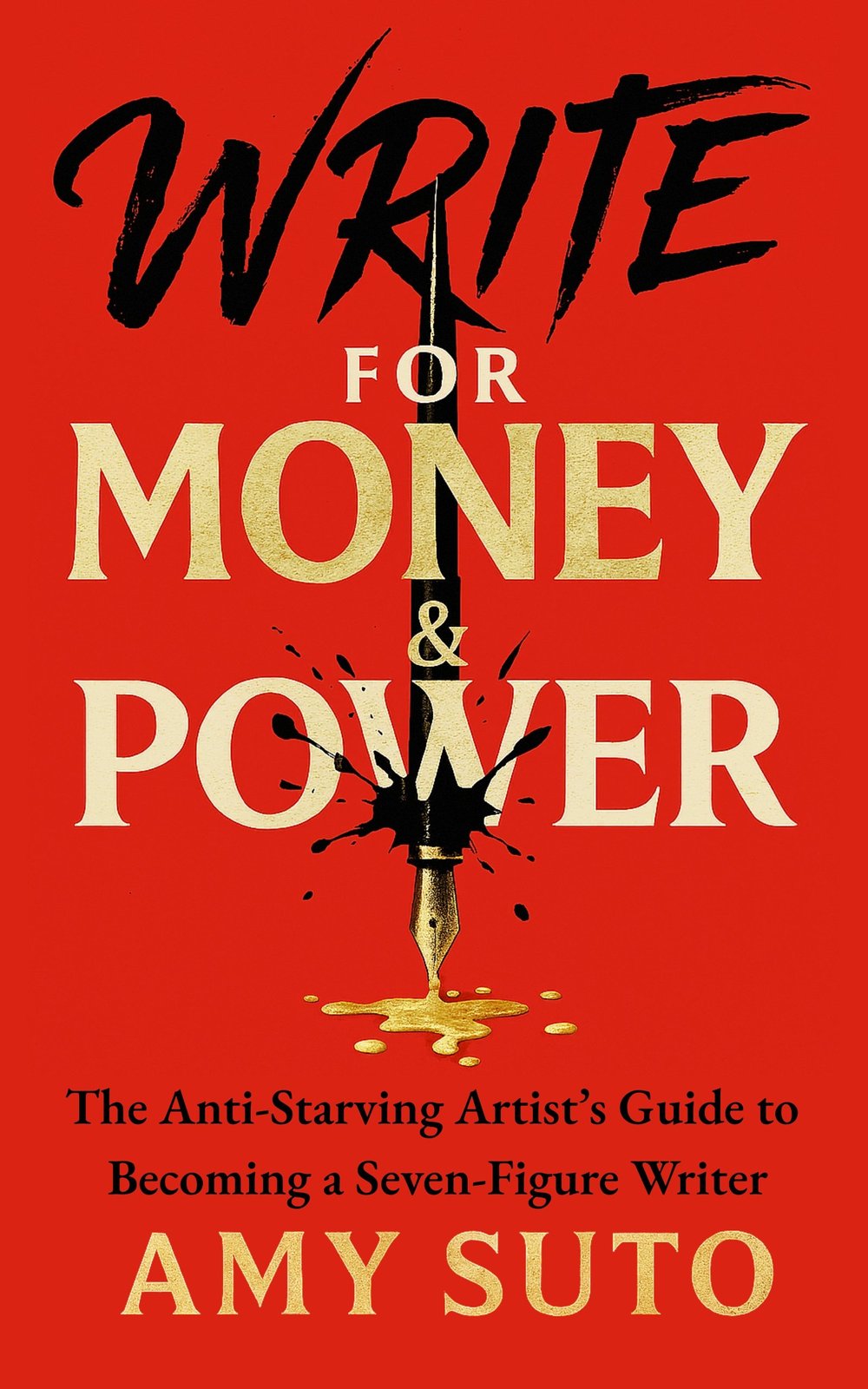
The anti-starving-artist's guide to becoming a seven-figure writer.
MY NEW NOVEL: LET ME BE YOUR GHOST

My romantic thriller arrives November 2026 — a ghostwriter with secrets, a billionaire CEO with more. Preorder one book, get two. Claim your bonus here →
MY ROMANTASY NOVEL: THE ASH TRIALS

The deadliest game is remembering who you are.
MY DETECTIVE NOVEL: THE NOMAD DETECTIVE

Crime crosses borders, but so does this detective.
MY HOW-TO BOOK: SIX-FIGURE FREELANCE WRITER
Work smarter, not harder — without the burnout.
RECENT POSTS
JOIN THE WRITING JOB BOARD
FOLLOW ME ON IG @SUTOSCIENCE