Astrocartography Chart: My Accidental 5-Year Experiment

Buenos Aires — still the city I measure every other city against.
You do not really know somebody until you have changed countries with them. That is when you get to watch your friends turn into different people.
I spent five years as a digital nomad, and for long stretches of it I traveled with big groups of remote workers. We’d overlap for a month in one country, scatter, then reunite on another continent. Same faces, new city, over and over. It was the closest thing I’ll ever get to running a controlled experiment on what geography does to a personality. It’s also the reason I take an astrocartography chart more seriously than I ever planned to.
One of our nomad friends introduced the group to astrocartography along the way, and the more cities we collected, the harder it got to dismiss.
An astrocartography chart maps where every planet sat relative to Earth at the exact moment you were born, then draws lines across the globe marking where each planet’s themes — luck, money, communication, discipline — show up loudest in your life. Live near your Jupiter line, the old astrologers say, and fortune finds you. Live near Saturn’s and you’ll get very good at hard lessons.
What Is Astrocartography? The Two-Minute Version
Regular astrology reads the sky from the one spot where you were born. Astrocartography (also called locational astrology, or an astrology map) asks a better question: what if you moved?
At the moment of your birth, every planet was directly overhead somewhere on Earth, rising over one horizon and setting over another. An astrocartography map draws those positions as lines around the globe, and astrologers read each line by its planet:
Jupiter line: luck, growth, doors opening a little too easily
Venus line: money, beauty, and cities where you feel like the main character at dinner
Mercury line: writing, communication, ideas that arrive fully dressed
Sun line: visibility, the places where you get noticed
Moon line: home-feeling, softness, emotional volume turned up
Saturn line: discipline and dues-paying (respect it, don’t move to it lightly)
Your exact birth time matters more here than almost anywhere else in astrology, because the sky moves fast. A few minutes of rounding can slide a line a real distance across the map. Dig out the birth certificate.
The Five-Year Experiment I Didn’t Know I Was Running
My nomad years ran on a simple system: a month per city, find a gym, say yes to the group dinner. Across five years, that added up to living out of a carry-on in more than 20 countries, often alongside the same rotating cast of nomad friends.
Which means I got a data set almost nobody gets. Spend a month in Japan with someone, then a month in Buenos Aires with that same person, and you’ll notice things their hometown friends never see. One friend was calm and centered in one country and a full party animal in another — same job, same laptop, same human, completely different frequency. When they later pulled up their astrocartography chart, the lines matched what we’d all watched happen in real time.
I felt it too. I was somebody slightly different in every country, and in a handful of cities the right things kept happening, one after another, until it stopped feeling random. When I finally looked at my own chart, the cities where I’d felt luckiest were sitting on or near the lines that supposedly mean exactly that.
I did not have a word for any of this in year one. I just knew certain cities felt like tailwind.

Tokyo — same friends, different frequency.
Is any of this science? No. I’m a writer, not an astrophysicist, and I can’t peer-review a vibe. Plenty of nomads in our groups rolled their eyes at all of it and had perfectly lucky years anyway. For me, tarot and astrology have never been about predicting the future: they’re tools for asking better questions in the present. Astrocartography just asks the most practical question in the deck: where should I be standing?
The chart is a lens, not a leash.
How to Read Your Astrocartography Map Without Paying for a Reading
You need exactly three things: your birth date, your birth city, and your birth time down to the minute. The time is usually printed on your birth certificate, and yes, it’s worth the call to your mom to confirm it.
Free tools will draw the astrocartography map for you. Astrodienst’s AstroClick Travel is the classic one astrologers themselves use. Once your lines are on the screen:
Start with the six big career lines: Jupiter, Venus, Mercury, the Sun, the Moon, and Saturn.
Look for overlaps. One line through a city is interesting. A city sitting near several friendly lines is worth an actual visit.
Mind the orb: astrologers read a line’s influence as stretching a few hundred miles to either side, so you don’t need to live on top of it.
Do not sign a lease off one line. Visit first. A chart has never once checked the rent.
Want the line-by-line version? I broke down what each planet’s line traditionally means, starting with the one everybody hunts for, in astrocartography lines, explained.
The Astrocartography Quiz That Also Checks Your Rent
Okay, yes — my husband Kyle and I built this one. But hear me out.
After I came home from the nomad years (I quit because I was tired of transience, not travel), we started building cozy little career quizzes into CozyJobs, our job board. The astrocartography one is the quiz I spent five years wishing existed.
Where In the World Is Your Career Luckiest? computes your actual chart — all six planetary career lines, with Jupiter’s luck line, Mercury’s writer line, and Venus’s money line among them — finds the cities they run through, and then does the thing astrologers never do: it checks whether you can actually afford to live there. Cost of living, real numbers, no incense required.
It also pairs your cities with live listings from the board, plus remote roles you could take from any line you like. It’s free, and it needs your exact birth time. (The sky moves fast, remember.)
And if you want the unmystical version of the same question, I wrote up the framework I actually used to pick cities for five years in where should I live.
And if you like your career questions in quiz form, the astro quiz has twenty shelf-mates. I ranked all 21 in my guide to the best free career quizzes, graded on whether they end in jobs you can actually apply to.
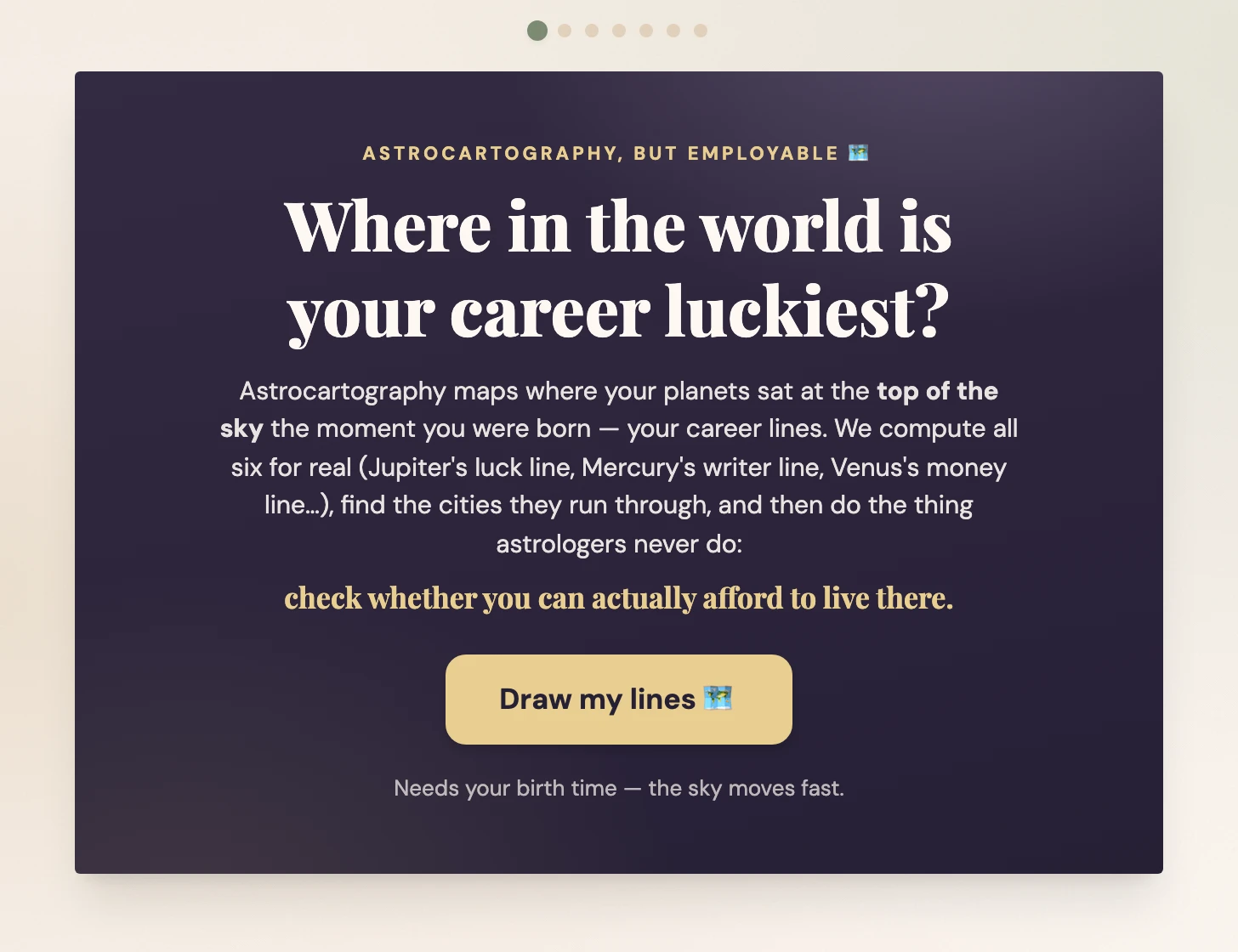
Real computed lines, then the unglamorous math.
It lives alongside 20 other free career quizzes on the CozyJobs quizzes shelf: a career tarot pull, a numerology reading, and a full cosmic reading of your big three, which I broke down in my career horoscope guide.
And if the job part is the part you need first: 🛋️ CozyJobs is the coziest job corner of the internet — thousands of jobs on a board updated daily, creative and freelance roles front and center, and the application tracker is free. It’s $25/month, or two months free with the annual plan at $250/year.
FAQ: Astrocartography Basics
What is astrocartography?
Astrocartography is a branch of astrology that maps your birth chart onto the globe, drawing planetary lines through the places where each planet’s themes are said to run strongest for you. Astrologers use it to read how different locations might change your luck, career, relationships, and energy.
Is astrocartography real?
There’s no peer-reviewed evidence behind it, and I won’t pretend otherwise. What I have is five years of accidental field notes: the same friends behaving like different people in different countries, and my own luckiest cities lining up with my chart. I treat it the way I treat tarot, as a tool for asking better questions, for entertainment (and occasionally employment) purposes.
Do I need my exact birth time for astrocartography?
Yes, more than anywhere else in astrology. The angles your lines are built from shift quickly as the Earth turns, so even a rounded-off birth time can move a line. Your birth certificate usually lists the exact minute.
What is a Jupiter line in astrocartography?
Your Jupiter line runs through the places where Jupiter was rising, setting, or directly overhead at your birth. Jupiter is the planet of luck and growth, so astrologers read Jupiter lines as the classic “move here and doors open” lines. It’s the first one most people hunt for on their map.
Can astrocartography tell me where I should live?
It’s one input, not a verdict. A good where-should-I-live decision stacks your chart against the boring, load-bearing facts: cost of living, visas, time zones, the people you love. That’s exactly why our quiz pairs your lines with rent math and real job listings instead of stopping at the map.
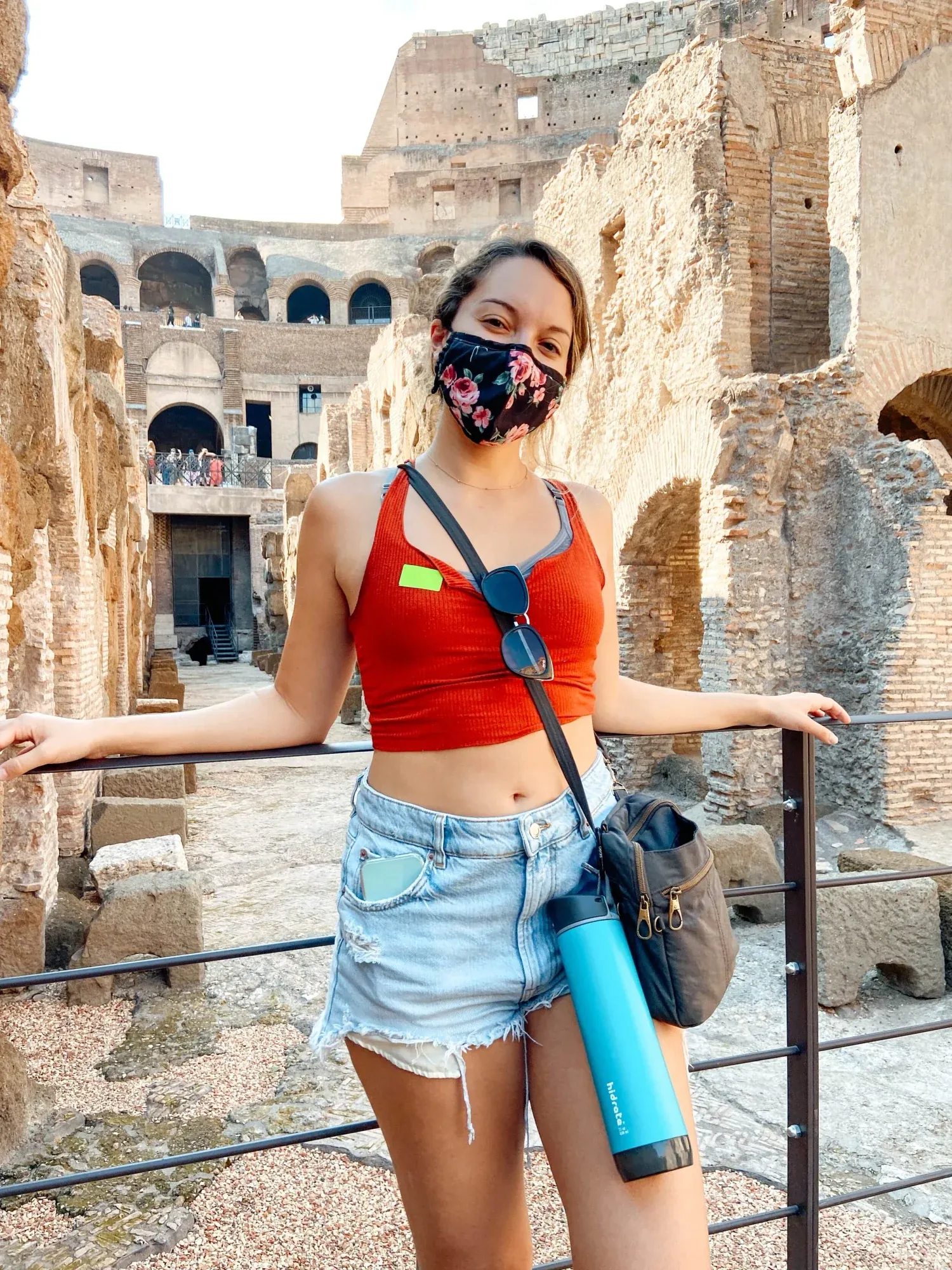
Rome, back when my office changed monthly.
Wherever your lines run, I hope you get to go stand on a few of them: take the month, book the flight, and watch who you become there. That’s the version of this experiment I can promise works.
I’m rooting for you.
More From My Nomad Years
My Digital Nomad Story — how a cheap-Airbnb road trip in 2020 turned into five years of living out of a carry-on
Working Remotely in Buenos Aires — my guide to my favorite city in the world
Working Remotely in Tokyo — my digital nomad guide to Japan’s capital

Hello! 👋 I’m Amy Suto. I’m a bestselling author, San Francisco content creator, and co-creator of the job board 🛋️ CozyJobs. Join CozyJobs to browse thousands of jobs and get daily matches to your inbox — writing and creative roles front and center!
GET ON THE LIST
Find your next writing job on 🛋️ COZYJOBS — thousands of jobs on a board updated daily, writing and creative roles front and center. ✨ The application tracker is free (basic CozyApply autofill is too), and paid plans start at $25/month with daily job matches straight to your inbox. Real writers are landing real work—don’t miss out.
FOLLOW ME ON GOOGLE
Add me as a preferred source and Google shows you more of my posts in Top Stories.

MY NEW BOOK: WRITE FOR MONEY & POWER
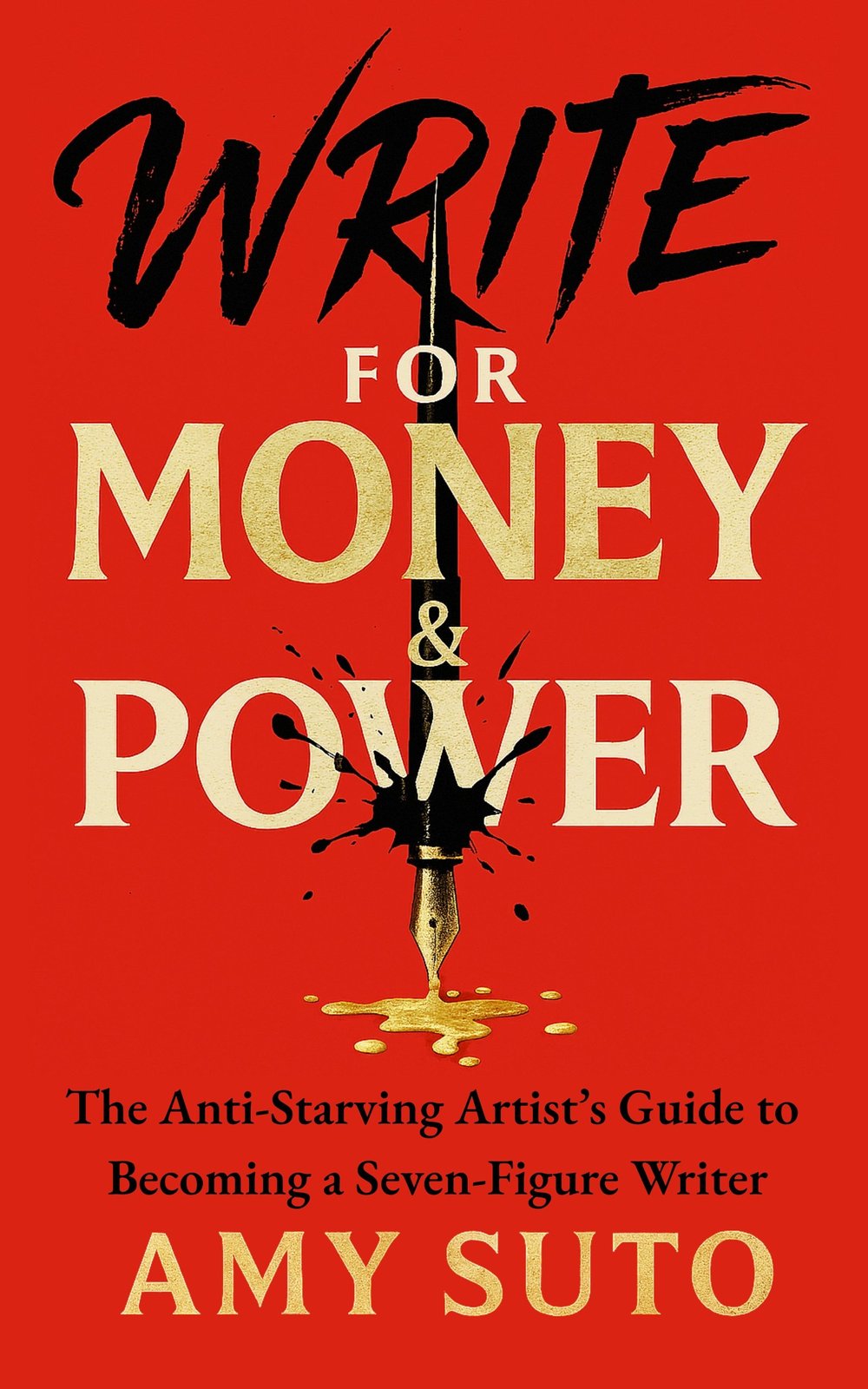
The anti-starving-artist's guide to becoming a seven-figure writer.
MY NEW NOVEL: LET ME BE YOUR GHOST

My romantic thriller arrives November 2026 — a ghostwriter with secrets, a billionaire CEO with more. Preorder one book, get two. Claim your bonus here →
MY ROMANTASY NOVEL: THE ASH TRIALS

The deadliest game is remembering who you are.
MY DETECTIVE NOVEL: THE NOMAD DETECTIVE
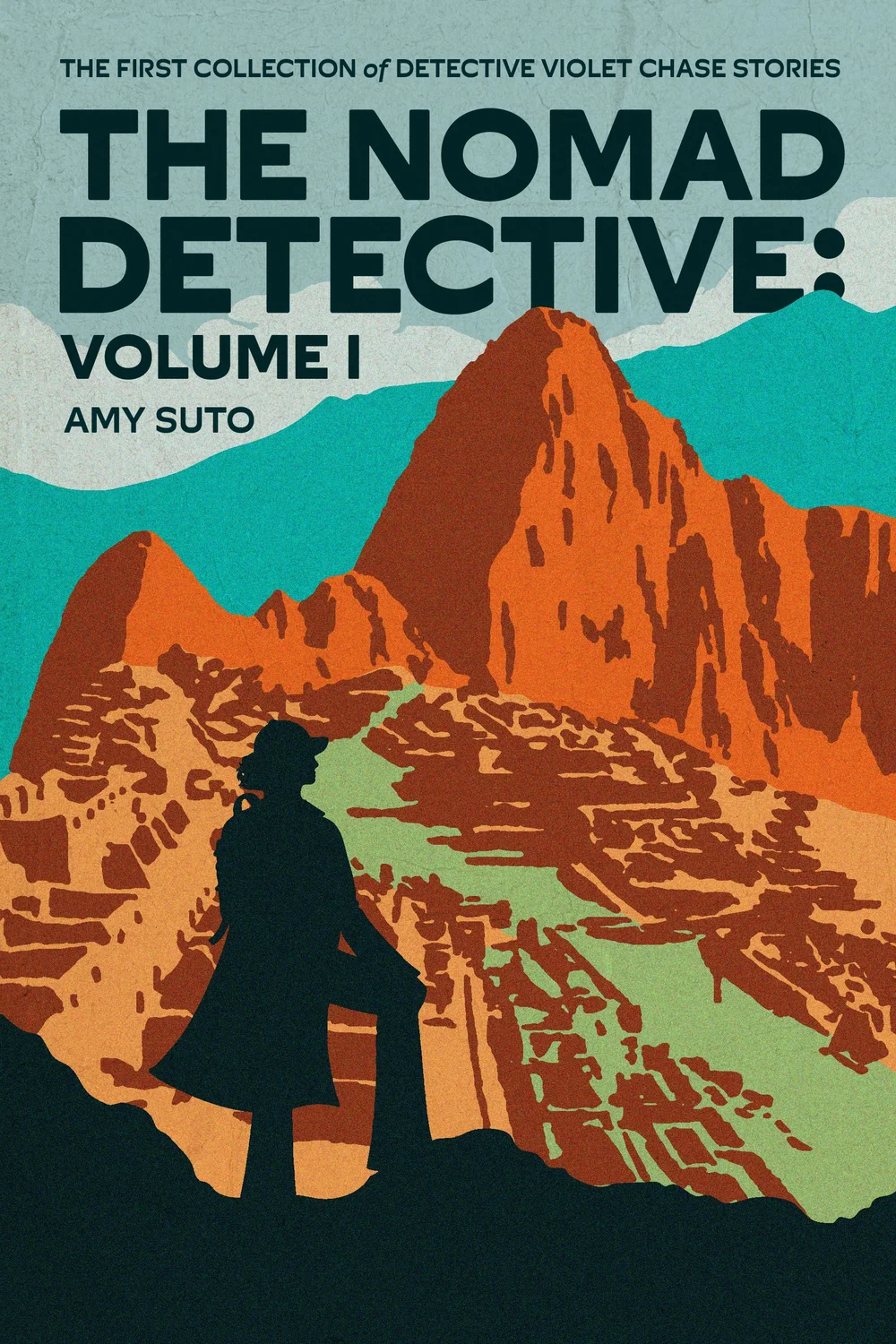
Crime crosses borders, but so does this detective.
MY HOW-TO BOOK: SIX-FIGURE FREELANCE WRITER
Work smarter, not harder — without the burnout.
RECENT POSTS
JOIN THE WRITING JOB BOARD
FOLLOW ME ON IG @SUTOSCIENCE