
Working Remotely in Seoul, South Korea
This is part of my remote work travel series where I review places I visit as a digital nomad. Check out the rest of my posts and follow me on Instagram, YouTube, Substack, or on TikTok for more travel content!
Listen, if you’ve been following my Substack publication you’ve already read about how Seoul just hits different in so many ways. You show up to the gym: workout clothes are waiting for you. You’re done with a hike: no problem, just blow the dust off your shoes at the dust-blowing station!
The subways and city streets are quiet and clean, the bus is a joy to ride on — and the Blue Bottle. Don’t get me started on Blue Bottle Coffee here. I’ve never tasted coffee so good, and Korean Blue Bottle puts the United States versions to shame.
However, life isn’t all sunshine and roses in Seoul: it’s a harder city to live for longer periods of time in, and it’s one of the least vegetarian-friendly cities I’ve ever been in — it’s very anti-vegetarian. If you want to eat something other than meat here, you’re basically ostracized from the culture.
But Seoul is a great place to visit for nomads, so let me share all of my tips and tricks with you in this comprehensive travel guide:
Where to Stay in Seoul, South Korea for Digital Nomads + Remote Workers
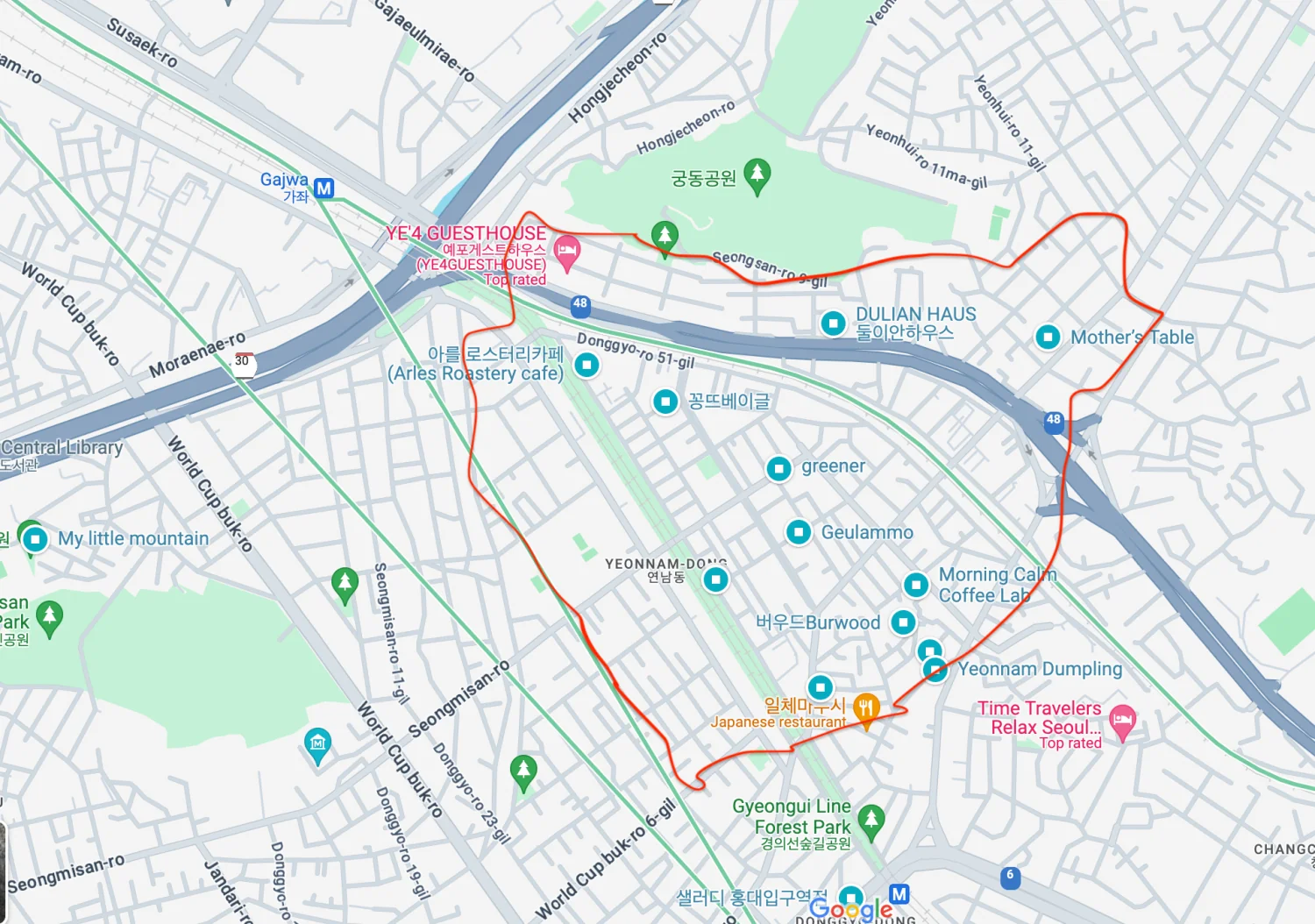
We stayed in the Yeonnam-Dong neighborhood, which is a university neighborhood in central Seoul. I loved this neighborhood because there are so many amazing coffeeshops, restaurants, and dessert places — but it’s a lot quieter and cuter compared to other more urban parts of Seoul. I definitely felt the college town vibes, and it almost felt like the “Brooklyn” to the Manhattan of Seoul, Gangnam, which is a 40-minute train ride away.
If you’re staying for longer than a week in Seoul, I’d recommend staying in the red square above. You’re a quick bus ride to the palaces and museums, and Gangnam isn’t too far, either.
While we did go to Gangnam a few times for events, dinners, and activities, I didn’t feel like I was missing out on anything by not staying there. I felt like the brunch places and coffeeshops were way better in Yeonnam-Dong compared to the rest of the city.
There are some co-lives like Trick Art Guest House and Hoppin Life in this area, but you can also find Airbnbs as well.
RELATED: The Best Travel Cards for Digital Nomads
4 Things to Know About Seoul, South Korea for Digital Nomads + Remote Workers
There are a few things you’re going to need to square away when you first arrive:
Get a T-Money Card from a Local Convenience Store. You need a T-Money card to ride public transportation (buses and the metro) which is the best and easiest way to get around Seoul. Go to any local convenience store and ask for a T-Money card you can load up with cash there in-store.
Download Naver Maps and KakaoMap. Frustratingly, Google Maps doesn’t really work in Seoul. National security or something. (Don’t ask me: I don’t know why North Korea would gain an upper hand by knowing where the best cafes are in the city.) You’ll need to download both Naver Maps and KakaoMap to be able to navigate the city, find places to eat, and use public transportation. I still used Google Maps to save my favorite places, but you’ll need these local map apps to cross-reference directions, hours, and find places that aren’t on Google. Even more annoying, there are places that are on Google Maps that aren’t on Naver or Kakao! To make things more challenging, Naver and Kakao have sections of their apps that are only in Korean, so finding things like restaurant hours can be a bit of a puzzle. The turnover of restaurants and coffeeshops is also pretty high here, so there were more than a few occasions where I would follow Naver’s directions and end up at a construction site or an empty building. This is why Seoul wins my personal award of “least accessible city” — an honor considering I’ve traveled to quite a few in my 4 years of full-time travel.
Google Translate Works… Sometimes. Translating Korean is a mixed bag at times, leading to some funny mistranslations. Be patient — and grateful for the locals who speak English. If you’re going to be in Seoul for a while, I recommend using Duolingo to get the basics of the Korean alphabet so you can at least read Korean, but otherwise the Google Translate app will be your best friend :)
Learn Korean etiquette. One of the top etiquette tips I looked up before arriving was that when you hand someone something, give it to them with two hands. If you only have one hand available, touch your arm with your other hand. This is polite in Korean culture. You’ll catch onto this quickly when you see the locals do this as well. In addition to this, trash sorting is a big deal and a bit of a pain, and they take recycling seriously here.
What to Do in Seoul, South Korea for Digital Nomads + Remote Workers
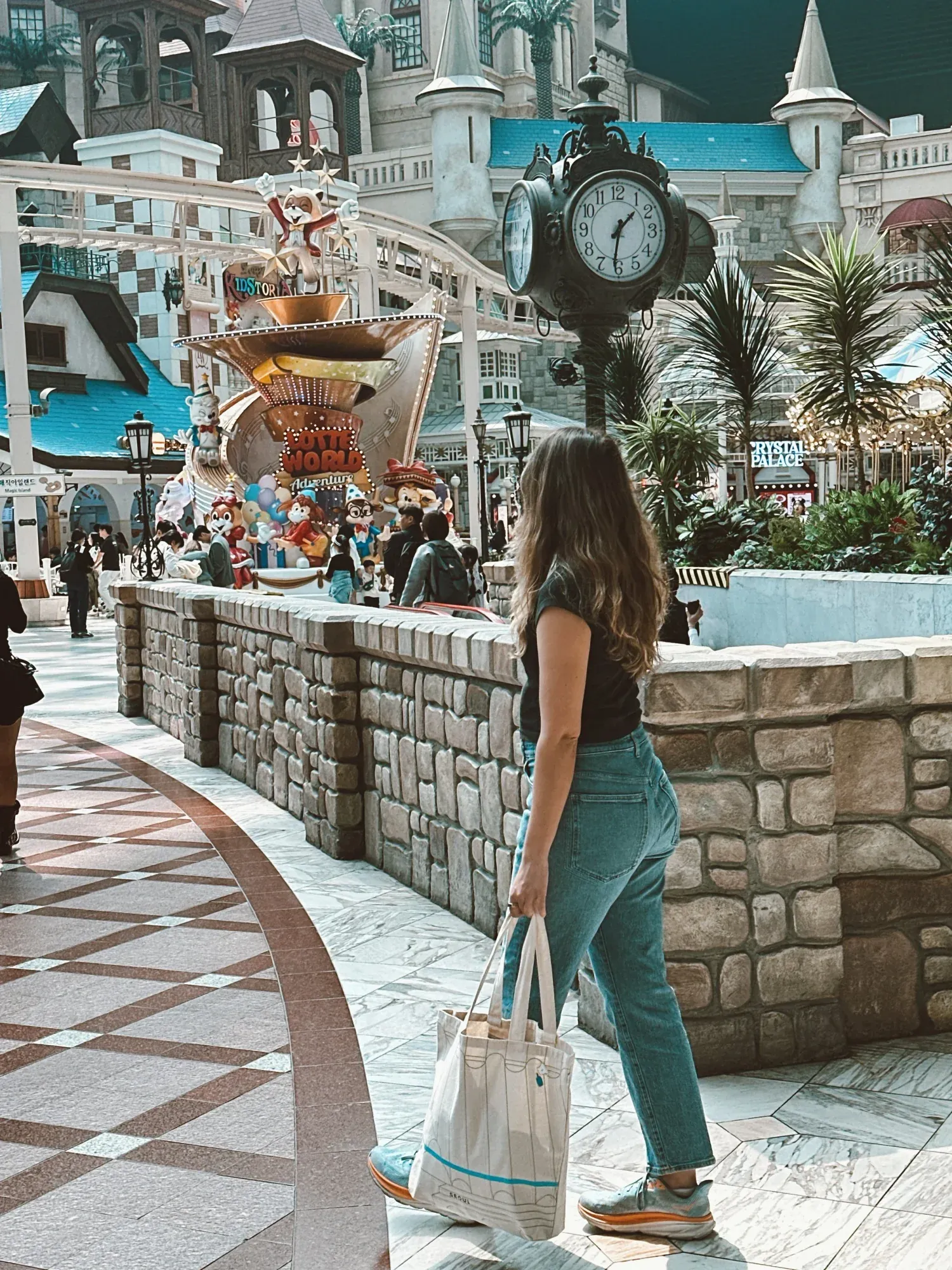
Ripoff Disneyla—I mean, Lotte World!
There is so much to do in Seoul. We did a lot, but below are my favorite activities in the city:
Fortress Night Hike. This tour was incredible: we started with some snacks at a local market which were delicious — and something we definitely couldn’t have done on our own as it was a hard-to-find local market. Then, we ascended a nearby mountain by the fortress walls for a night hike to catch sunset and the views of the city at night. One of my favorite tours: the hiking part was really lovely and much needed after our long flight over here!
KPop Dance Class. I’m a huge K-Pop fan, and this dance class was taught by a great instructor. They also filmed the last 10 minutes of class, and the video was a fun souvenir of our trip.
Night Market Tour. There are so many different options for night market tours, so I recommend picking a highly rated one like this night market tour. Myeong Dong is one of the most popular night markets, and I recommend visiting with a tour as it’s crazy packed and hard to explore on your own: it’s better to have a local guide help you navigate and highlight the best stuff!
Free Tour at the Gyeongbokgung Palace and Explore the Bukchon Hanok Village. You can spend a full day at the Gyeongbokgung Palace, where entry is something like $3. There, you can get a free tour in English (check the times before you go!) and then afterward explore the nearby Bukchon Hanok Village and cultural center. I recommend grabbing a snack to-go at Onion Cafe (to avoid the long lines). Their sweet garlic bread was to die for. You can find more in-depth tours for both of these areas, or you can just wander around yourself.
Explore Gangnam. I, like everybody not living under a rock, had heard the song Gangnam Style and was curious about this infamous neighborhood. In reality, it feels similar to Rodeo Drive but more downtown-ish. Lots of big buildings, offices, and busy streets. The mall over here is cool with the Starfield Library, but everything is pretty touristy. Nice for a short visit or if you’re here for a planned activity, but otherwise I don’t love Gangnam.
Lotte World Amusement Park and Mall. Imagine that someone with amnesia went to Disneyland 15 years ago, and then decided to rebuild the park in a 6-story mall in the middle of Korea. Welcome to Not-Disneyland! Lotte World is a funny, weird half-indoor, half-outdoor amusement park with forgettable rides like Pharoah’s Revenge (an Indiana Jones Ripoff) and Comet Express (Space Mountain, but each seat spins! So weird!). The big draw here is that everyone comes to the park dressed in rented school uniforms. Ewha School Uniform is what people recommend as they have a pink-themed photoshoot area. I skipped because I didn’t want to wear a miniskirt in the cold, but if you want a photo opp you know where to go! I’d give this place a 4/10 but it’s a fun place to visit if you want a weird little experience to enjoy with friends for a day.
Color Matching and Skeletal Analysis. I liked but didn’t love the place we went to for our color matching and skeletal analysis, so I’d recommend doing your own research to find a place to do color matching — a popular experience here in Seoul where they tell you what colors work best with your skin tone and hair color!
Head Spa. I didn’t do this personally, but a lot of people come to Korea for a scalp analysis and 10-step head spa experience. You’ll need to book in advance, and many of the places that do this require you to book through Instagram DM.
Go to Olive Young and shop skincare products. If you’re into skincare, you’re in the right city! Olive Young is this city’s Sephora — but with snacks! — and they’re everywhere. My favorite product line is Beauty of Joseon, and their sunscreen and sunscreen stick are out of this world. I had to go to a flagship store to find their products, so if you can’t find your favorites in your local store, try and find a bigger location.
A lot of people come to South Korea for plastic surgery and intense skincare treatments. I had a bunch of friends do different types of treatments, and they reported back and said it’s a lot cheaper here. However, it’s important you do your research and maybe even talk to locals before doing a treatment of any kind. A lot of these more intense skincare treatments can be painful, expensive, or invasive. My personal philosophy on this is for another post, but I think there are better things to spend your money on.
The Best Time of Year to Visit Seoul, South Korea for Digital Nomads + Remote Workers
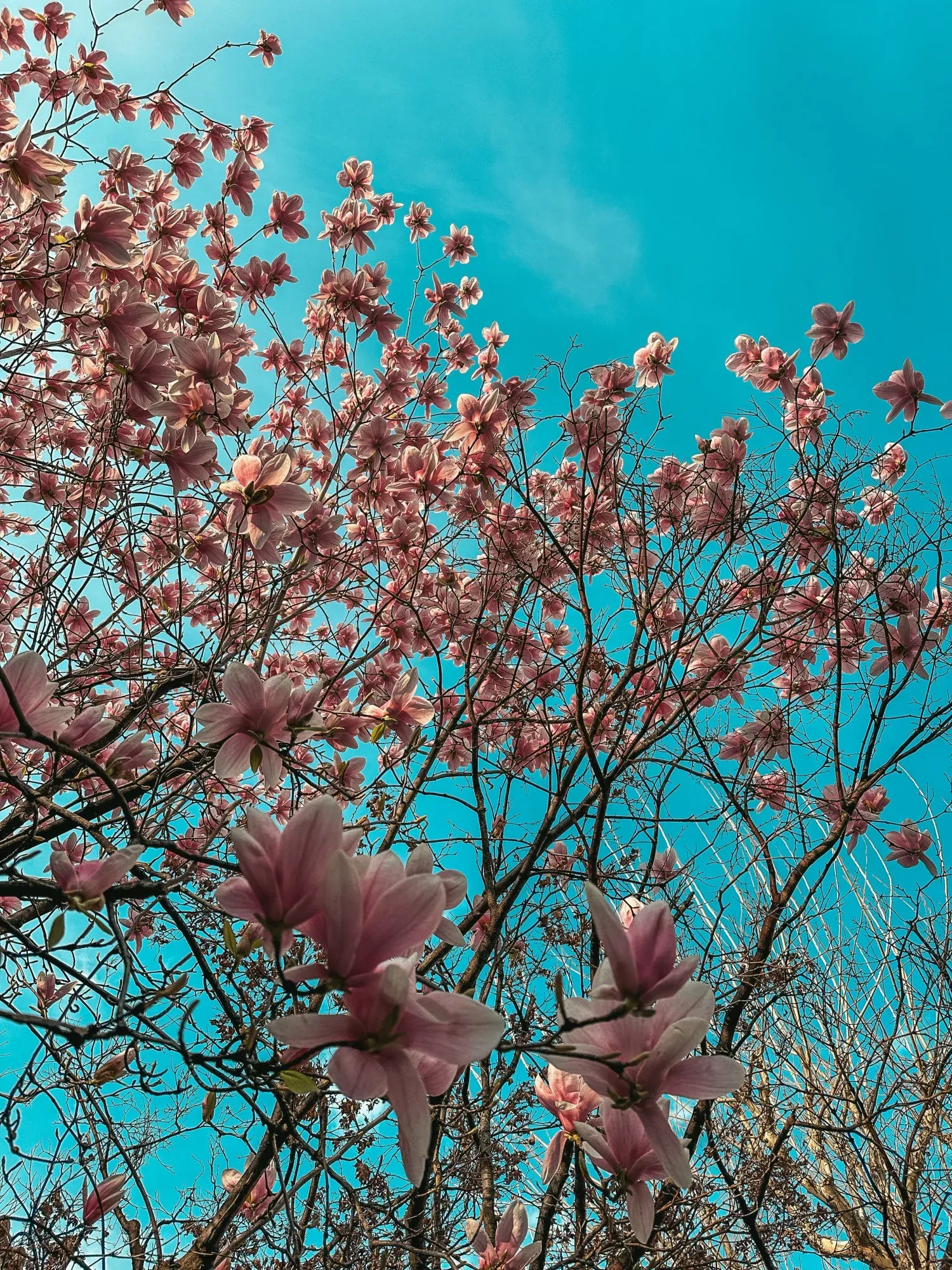
Spring or fall are the best times to visit: April is ideal if you want to catch cherry blossom season, but note that cherry blossoms sometimes bloom on their own schedule depending on the weather! At the tail end of March we had some cold weather (average days of 40 degrees Fahrenheit with wind chill!) so if you’re visiting in spring or fall make sure to pack a warm jacket.
I’ve heard that the summers here are super humid, which feels crazy as spring felt dry and I didn’t sense any humidity at all. Something to keep in mind if you’re not a fan of hot and humid summers.
Best Coffeeshops in Seoul, South Korea for Digital Nomads + Remote Workers
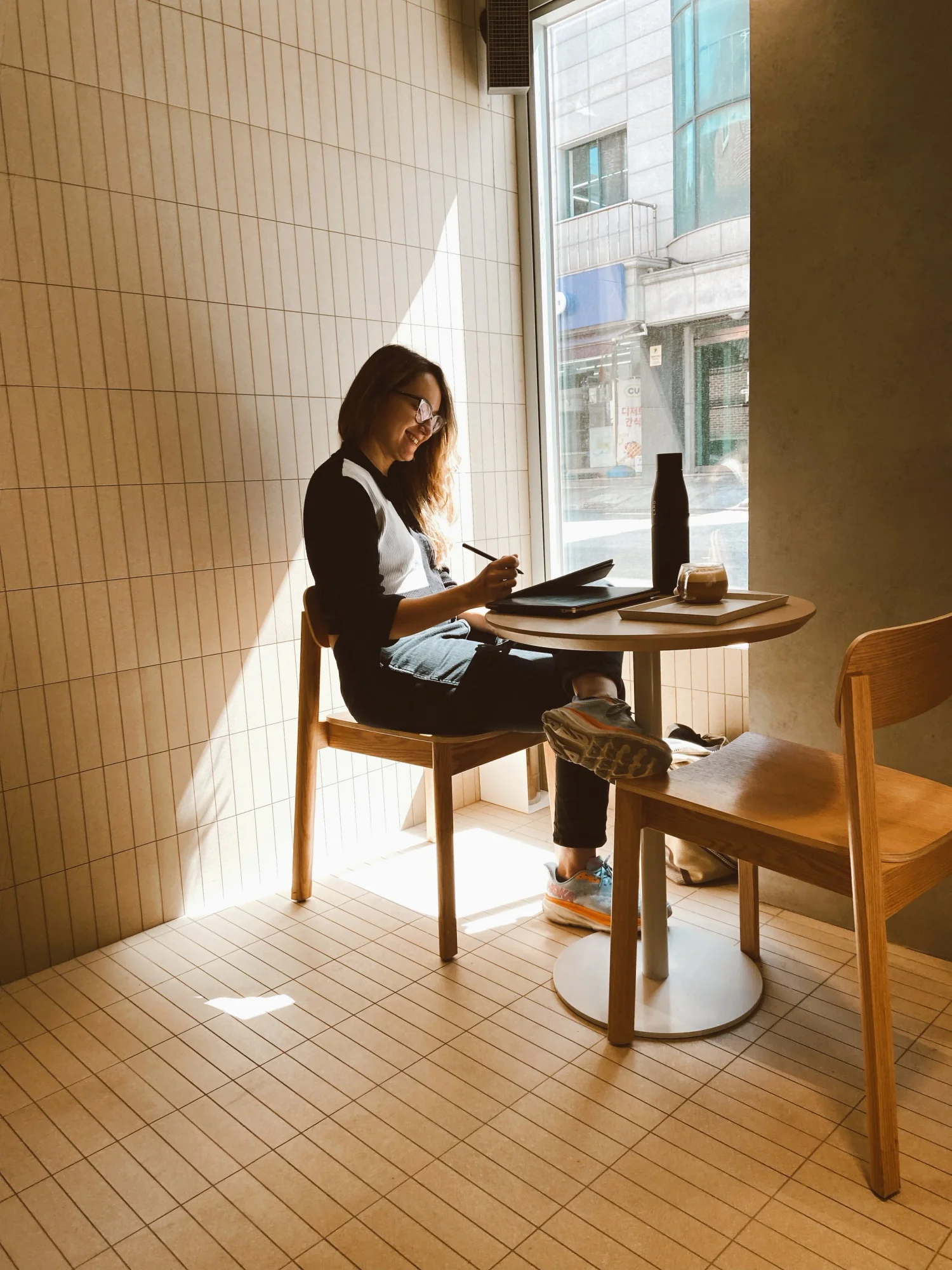
In my element at my favorite Blue Bottle location in Yeonnam-dong
There are over 20,000 cafes and coffeeshops in Seoul, and I tried quite a few. Friends of mine did the whole “theme coffeeshop” thing, going to the Harry Potter cafe and dozens of other kitschy spots.
However, there are two that became my must-visit:
Grain Seoul Cafe. This cafe is a perfect brunch spot and coffeeshop that became my daily go-to! I went for the brunch, stayed for the casual co-working. I recommend getting a build-your-own-brunch with a weekly juice and a flat white. Friends of mine would work here with their laptops from 9am-5pm, so this is a tried-and-true spot to post up and get some work done. Everyone is very nice here, and during the week it’s not too busy.
Blue Bottle. I’ve found that Blue Bottle Coffeeshops in the States are acidic, hard-to-drink coffee. But here? I’m obsessed. My daily drink is the Cherry Blossom Nola with a tropical pound cake. Heaven.
You can find rainforest cafes, waterfall cafes, cave cafes — and so many more. I tend to be coveting with my coffeeshop faves, but if you’re looking for inspiration I recommend scrolling through social media.
What to Eat in Seoul, South Korea for Digital Nomads + Remote Workers
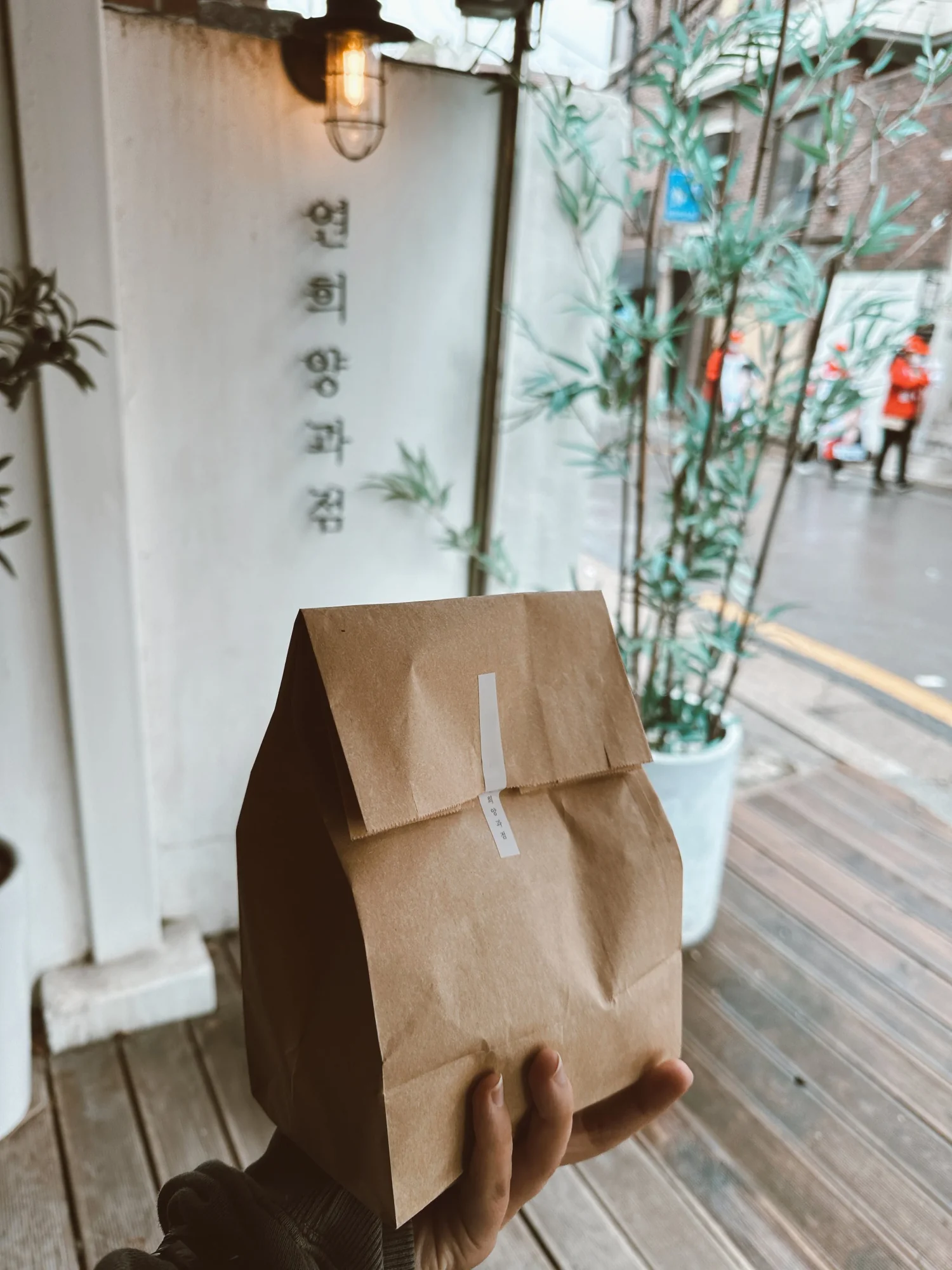
Pastries acquired at a local patisserie in yeonnam-dong
If you’re a meat-eater, you’re going to have endless ramen and Korean BBQ options to enjoy.
Below are the places that are inclusive of vegetarian diners like me that I loved — and most are located in and around Yeonnam-dong:
Brunch: Thanks Oat. This sustainable cafe has two locations, one in Yeonnam and one by the palace. The one in Yeonnam doesn’t have coffee, but is located next to the Blue Bottle. This location isn’t a traditional Western-style brunch: it has sandwiches, yogurt bowls, and acai bowls as well as a tea selection. It’s a cozy place to get a light breakfast or lunch before the day’s activities.
Brunch: Burwood. Burwood feels like a brunch place stolen right out of Venice Beach in California. Beachy vibes and indie music reminded me of my former home, but the Aussie Breakfast Plate and Croissant French Toast were to die for. Plus, their Dirty Chai Latte was pretty solid, a rare find here in Korea.
Brunch/Snack: SF Bagel. The owner of this bagel shop is super warm and friendly, and has great tips and recommendations for tourists! Plus, her homemade sourdough bagels and baked goods are absolutely delicious. Highly recommend this place for a light snack or lunch.
Dinner: Yeonnam Dumpling. This dumpling place is run on a tight ship: you can only order once, everyone is required to order at least 1 entree, and once you’re done eating they rush you out. All that said, this place is still worth it. They have two locations right next to each other, and have some great garlicky greens and excellent dumplings and veggie buns.
Dinner: Tuk Tuk Noodle Thai. This Michelin-star thai place was a spicy staple during our stay in Seoul. The pad Thai was excellent, and on the weekends they have a great coconut drink.
Dinner: High House. Right next to Tuk Tuk is a taco place called High House. They have some amazing veggie tacos (a surprisingly hard find in Seoul!) and use lovely fresh ingredients. My favorite place to get some quick take-out during a busy week.
Fine Dining Dinner: Mingles. My partner Kyle scored a hard-to-get reservation at Mingles. The night before our reservation, it was named the #1 restaurant in Korea, and became instantly booked out for 3 months. The service was amazing, the decor was calming, and the food fresh and tasty. They even had a vegetarian menu (amazing.) If you’re looking for some creative fine-dining, this is the best place in Korea to get it. However, I do think it’s a bit overpriced: some of my most favorite bites of food were the more simple food I tried at the local’s market tour on the Fortress Night Hike I mentioned earlier in this post. But if you want a true foodie experience, Mingles is going to be the place: just get your reservation months in advance.
Dessert: Milk Factory. The mochi red bean fish (an amazing, chewy and sweet dessert!) and bingsu (a Korean shaved ice dessert) are a must-try, and Milk Factory does them both so well.
Dessert: Yuki Mochi. This dessert place does the best ice cream mochi, where ice cream is wrapped with rice flour to create a chewy frozen dessert that’s to die for. Highly recommend the matcha flavor.
Health and Fitness for Digital Nomads and Remote Workers in Seoul, South Korea
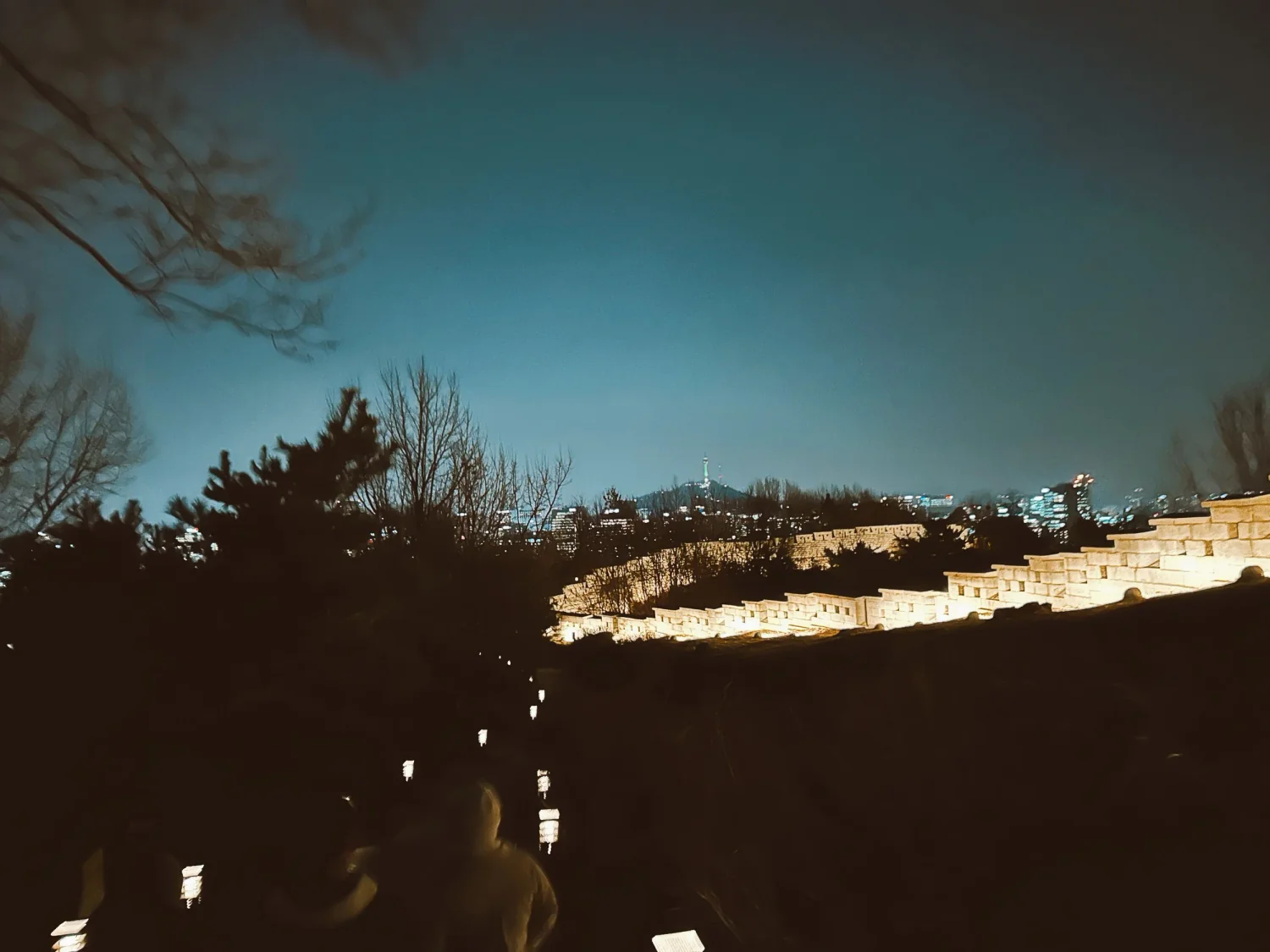
The pollution in Seoul is an issue: even the Namsan Seoultower lights up with different colors to show what the pollution level is (green = air quality is good!)
However, on days when the air quality is good, there are plenty of hikes around Seoul you can do. In Yeonnam-Dong there was even a cute mountain behind our house with some easy trails.
I recommend signing up for the Star Kali Fitness Gym. It’s a basement gym but with nice equipment, plenty of cardio machines, weights, a heated stretching room, a sauna, and strength training machines. It even has a pilates class area, but you can only take pilates classes with a 3-month or longer membership. Our month-long memberships cost $100 per person per month. Not bad, but definitely a little more pricey than month-long memberships in other cities — and this gym was much cheaper than other options.
Staying healthy in Seoul can be a bit tricky: there are tons of desserts and fried foods everywhere, and even savory foods have sugar in them. Workout classes are hard to book here as most places want foreigners to book via DM or a complicated booking process.
One of my friends said it best: South Korea has the technology to make life easier, it’s just that these booking platforms are not made for foreigners to use. Quite literally as a lot of services here often require Korean phone numbers. This isn’t necessarily a bad thing, it’s just a bit more challenging to
My Ratings of Seoul, South Korea as a Digital Nomad
Affordability: ⭐️⭐️ (2/5 — not the cheapest destination I’ve been to, but also not the most expensive. My daily food cost came out to around $30-$40/day, and that’s with only eating out and includes all coffees, tea, juices, daily brunch, a gimbap for lunch that I split with my partner, and dinner and dessert somewhere in the city. I didn’t cook this month because I heard from others that groceries were more expensive than eating out.)
Food Quality: ⭐️⭐️ (2/5 — there’s some good food here, but it’s very meat-heavy.)
Vegetarian Options: ⭐️ (1/5 — you’re going to have a really hard time if you don’t eat meat. I would not recommend for vegetarians.)
Adventures/Day Trips: ⭐️⭐️ (2/5 — there are day trips like the DMZ, Jeju, and Busan, but you need to go during the right season and Busan and Jeju seem to skew more touristy.)
Cafes/Co-Working Space Availability: ⭐️⭐️⭐️⭐️⭐️ (5/5 — the cafes are incredible, and are very laptop friendly—especially in University neighborhoods where students spend a lot of time studying.)
Digital Nomad-Friendly City: ⭐️⭐️ (2/5 — a lot of young people are friendly and nice, but overall this city isn’t very accessible for nomads. The language barrier can make you feel isolated, and the older generation seems a lot less friendly and pretty annoyed by the presence of tourists. The lack of options for people who are vegetarian or have dietary restrictions also makes this a tough city to live in for longer periods of time, and even booking things like hair appointments or yoga classes was a complicated chore.)
Value of Accommodations for Remote Workers: ⭐️⭐️ (1/5 — Airbnb prices aren’t bad, but it’s not going to be the cheapest place you’ve ever stayed.)
Air Quality: ⭐️ (1/5 - the air condition was often “unhealthy” and on two days it was so bad we had to wear masks)
Water Quality: ⭐️⭐️⭐️⭐️ (4/5 - our house had a water filter and when we tested the water with our water meter, the quality was great with low parts per million)
Overall Rating: ⭐️⭐️ (2/5 — while it’s worth visiting, I wouldn’t recommend Seoul for longer stays)
If you liked this post, be sure to subscribe to my newsletter and check out the rest of my remote work series. You can also follow me on YouTube, Instagram, Substack, or on TikTok to join me in my journeys in real time. I can’t wait to continue to share my travels with you!
Want a Remote Job and Travel the World?
You know the spiral: 47 tabs open, the same resume copy-pasted into 12 different forms, every "we'll be in touch" disappearing into the void. Upwork feels like a hunger games. LinkedIn easy-apply is a black hole. Your tracking spreadsheet has its own tracking spreadsheet.
Job hunting shouldn't feel like this.
That's why we built 🛋️ CozyJobs — the coziest job corner of the internet for finding (and actually landing) your next role. Best jobs on the web, autofilled applications, one place to track every move (with a lofi soundtrack to keep you in the zone).
Here's everything tucked inside:
🌐 Best Jobs on the Internet — curated remote, freelance, and full-time roles from across the web, all pinned to one tidy board
📌 One-Click Autofill — on supported sites, apply with a single click. No more typing your address for the 800th time
📋 The Cozy Tracker — every application pinned to your corkboard so you always know what's out there (and what's ghosting you)
🧠 Smart Job Matching — AI that surfaces roles that actually fit you, not just keyword soup
👤 Multi-Profile Support — different resumes for different vibes, swap with a click
📥 Save From Anywhere — drop in listings from LinkedIn, Indeed, or that random thread a friend sent
🎧 Lofi Job Hunt Radio — chill beats to bop through your search. Because applying shouldn't feel like a tax audit
Try CozyJobs today — bring the calm to your job hunt and see what happens.
Basically, everything you need to make your job travel with you. See you inside!
-Amy
Pin for Later!
p.s. I create my blog voiceovers and my podcast episodes using the tool Wondercraft AI, a text-to-speech tool that speaks in YOUR voice. 🎙 Use my code SUTO50 or this link to get 50% off your Wondercraft AI subscription!*
*These are affiliate links. Thanks for supporting this blog!
Hello! 👋 I’m Amy Suto. I’m a bestselling author, San Francisco content creator, and co-creator of the job board 🛋️ CozyJobs. Join CozyJobs to browse thousands of jobs and get daily matches to your inbox — writing and creative roles front and center!
GET ON THE LIST
Find your next writing job on 🛋️ COZYJOBS — thousands of jobs on a board updated daily, writing and creative roles front and center. ✨ The application tracker is free (basic CozyApply autofill is too), and paid plans start at $25/month with daily job matches straight to your inbox. Real writers are landing real work—don’t miss out.
FOLLOW ME ON GOOGLE
Add me as a preferred source and Google shows you more of my posts in Top Stories.
MY NEW BOOK: WRITE FOR MONEY & POWER
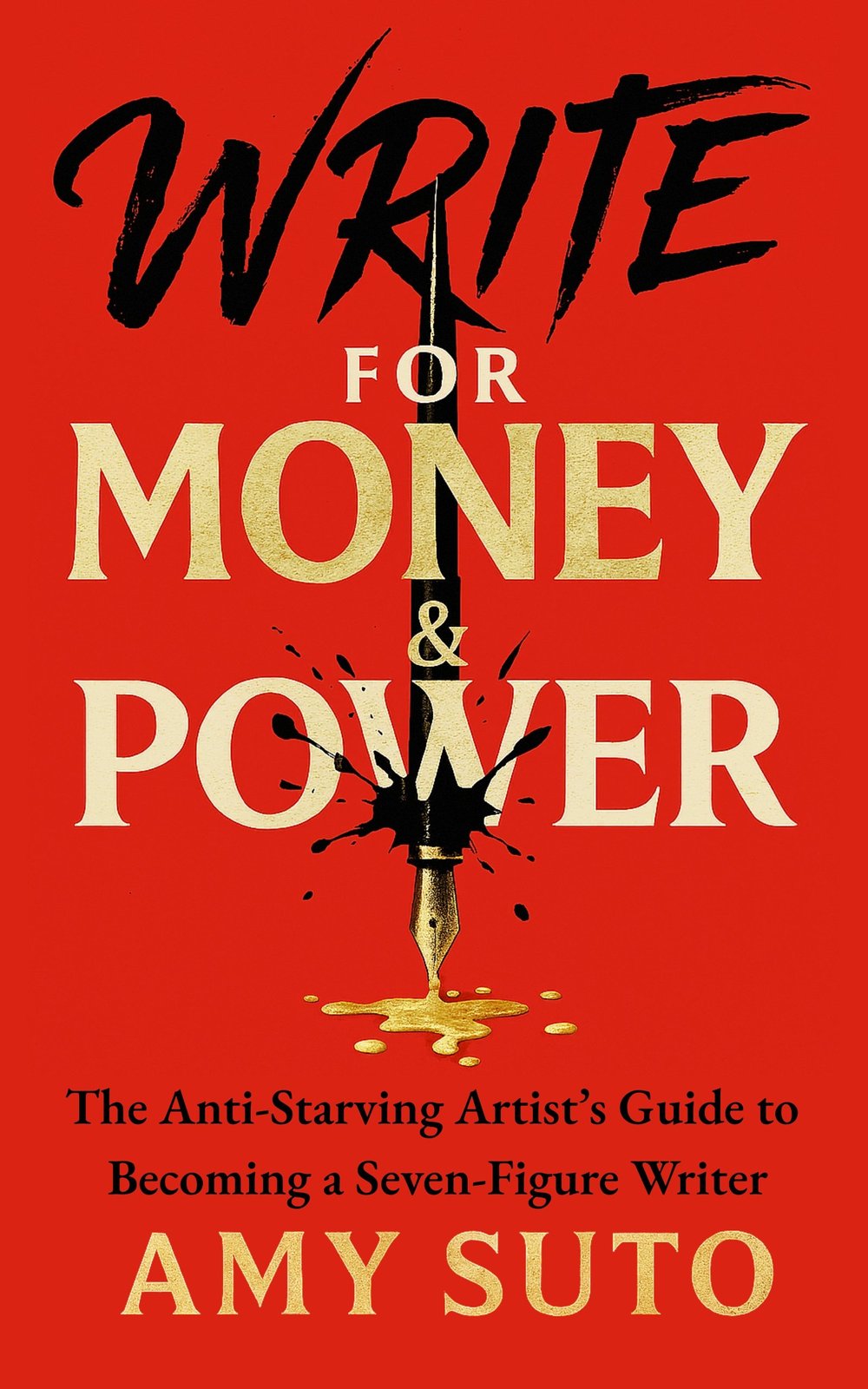
The anti-starving-artist's guide to becoming a seven-figure writer.
MY NEW NOVEL: LET ME BE YOUR GHOST
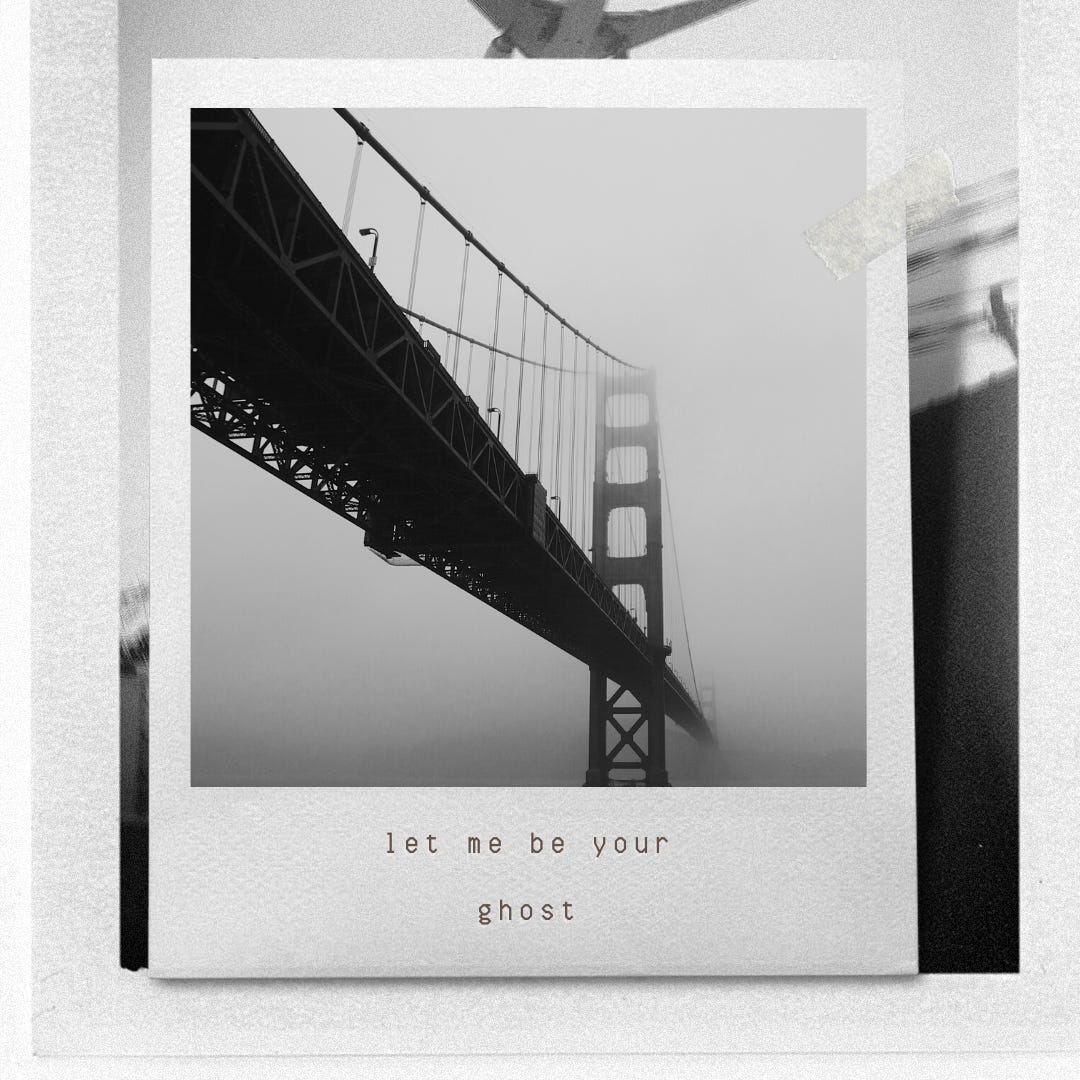
My romantic thriller arrives November 2026 — a ghostwriter with secrets, a billionaire CEO with more. Preorder one book, get two. Claim your bonus here →
MY ROMANTASY NOVEL: THE ASH TRIALS

The deadliest game is remembering who you are.
MY DETECTIVE NOVEL: THE NOMAD DETECTIVE

Crime crosses borders, but so does this detective.
MY HOW-TO BOOK: SIX-FIGURE FREELANCE WRITER
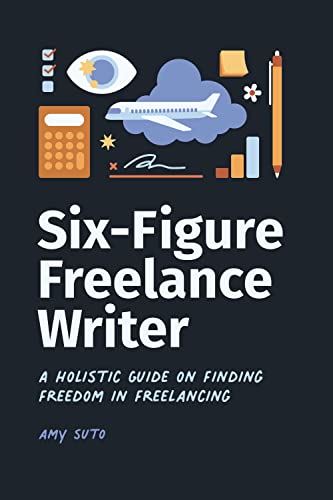
Work smarter, not harder — without the burnout.
RECENT POSTS
JOIN THE WRITING JOB BOARD
FOLLOW ME ON IG @SUTOSCIENCE

![🌁 chapter fifteen: the chamber [let me be your ghost]](https://substackcdn.com/image/fetch/w_480,c_limit,f_auto,q_auto:good,fl_progressive:steep/https%3A%2F%2Fsubstack-post-media.s3.amazonaws.com%2Fpublic%2Fimages%2F6b56d429-2b09-4a94-9b0f-415a889b419b_1080x1080.png)